

Three years ago, when we analyzed the State of Testing data, the message was clear: Communication was king. In 2023, the industry prioritized soft skills above all else, driven by the need to break down silos between QA and Development.
But 2026 paints a very different picture.
As we prepare to release the 13th State of Testing™ Report, early data reveal a profound shift in what defines a “Must-Have” skill. The rise of AI has commoditized routine tasks, forcing the human tester to evolve from an executor to a validator. The new mandate isn’t just about talking to the team, it’s about thinking critically about what the machines are building.
Here are the Top 5 Must-Have Skills for 2026, based on the input of thousands of QA professionals worldwide.
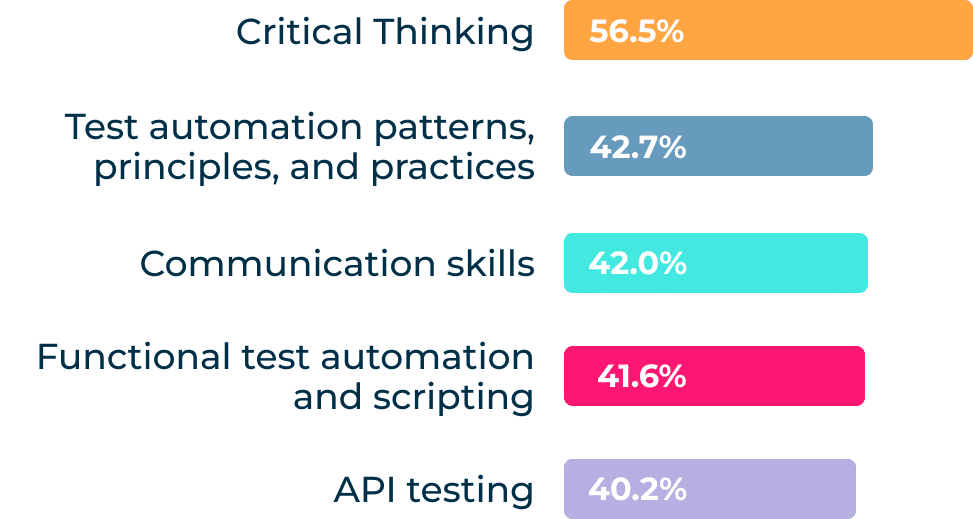
Skill #1: Critical Thinking (56.4%)
The New #1. In a massive upset, Critical Thinking has dethroned Communication Skills to take the top spot. Why? Because in an era where AI can generate code, test cases, and reports in seconds, the ability to validate those outputs is paramount. Testers are no longer just executing; they are investigating. Critical thinking is the safety net that prevents “AI hallucinations” from becoming production bugs. It’s the ability to look at a perfectly passing automated suite and ask, “Yes, but did we test the right thing?”
Skill #2: Test Automation Patterns & Principles (42.6%)
Architecture Over Scripting. It is telling that “Patterns and Principles” now ranks higher than generic “Scripting.” This signals a maturity in the market. Writing a script is easy (AI can do it for you). Building a maintainable, scalable framework is hard. In 2026, companies don’t just want someone who can code; they want engineers who understand design patterns (POM, Screenplay), DRY principles, and how to build automation architectures that don’t crumble under their own weight.
Skill #3: Communication Skills (42.0%)
Down from #1 to #3. While no longer the solitary king, Communication remains vital. However, its nature has changed. It is no longer just about “raising red flags” to developers; it is about acting as the translator between AI outputs and business stakeholders. With nearly 40% of practitioners reporting a gap in “Test Strategy,” the ability to communicate risk (not just bugs) to non-technical leadership is what separates a Senior QA Engineer from a Junior Tester.
Skill #4: Functional Test Automation & Scripting (41.3%)
The Efficiency Engine. Ranking closely behind the soft skills is the hard skill of execution. Functional automation remains the bread and butter of modern QA, but the expectation has shifted. It’s no longer enough to manually click through screens. The 2026 tester is expected to wield tools—whether it’s Playwright, Cypress, or Selenium—to automate the regression grind. The high ranking here confirms that, despite the rise of AI, hands-on technical capability is still the price of entry.
Skill #5: API Testing (40.5%)
The Invisible Layer. Rounding out the top 5 is API Testing. As modern architectures become more distributed and microservices-based, testing the “invisible layer” has become non-negotiable. For 2026, API testing is the efficiency hack. With the pressure to “Shift Left,” waiting for a UI to be built is a luxury teams can no longer afford. API testing allows QA to validate business logic the moment the code is committed, making it the backbone of any serious CI/CD pipeline.
See the Full Data Before Everyone Else
These 5 skills are just the tip of the iceberg. The full 2026 State of Testing™ Report uncovers deeper truths about salaries, the “AI Anxiety Gap,” and the tools that are actually paying off.
Want the full story? Join us for the exclusive State of Testing Roundtable, where we will debut the full report, debate the controversial findings, and answer your questions live.